LB DENTURE SERVICES
DENTURE CLINIC

Menu
Partial Dentures


‘Partial Dentures’ would be worn in a situation where some natural teeth remain in either the top of the mouth, (called a partial upper denture), or the bottom, (called a partial lower denture).
What Are My Options with Partial Dentures?
In general, there are two types of partial dentures that may suit your needs: ‘Cast Partials’ and ‘Acrylic Partials’.
1. Cast Partial Denture – sometimes referred to as a ‘metal denture’, this is a partial denture, (pink gum material and denture teeth), with a metal base, (made of Chromium Cobalt), and has on average 2-4 metal clasps that hook around any remaining natural teeth to help keep it in the mouth.
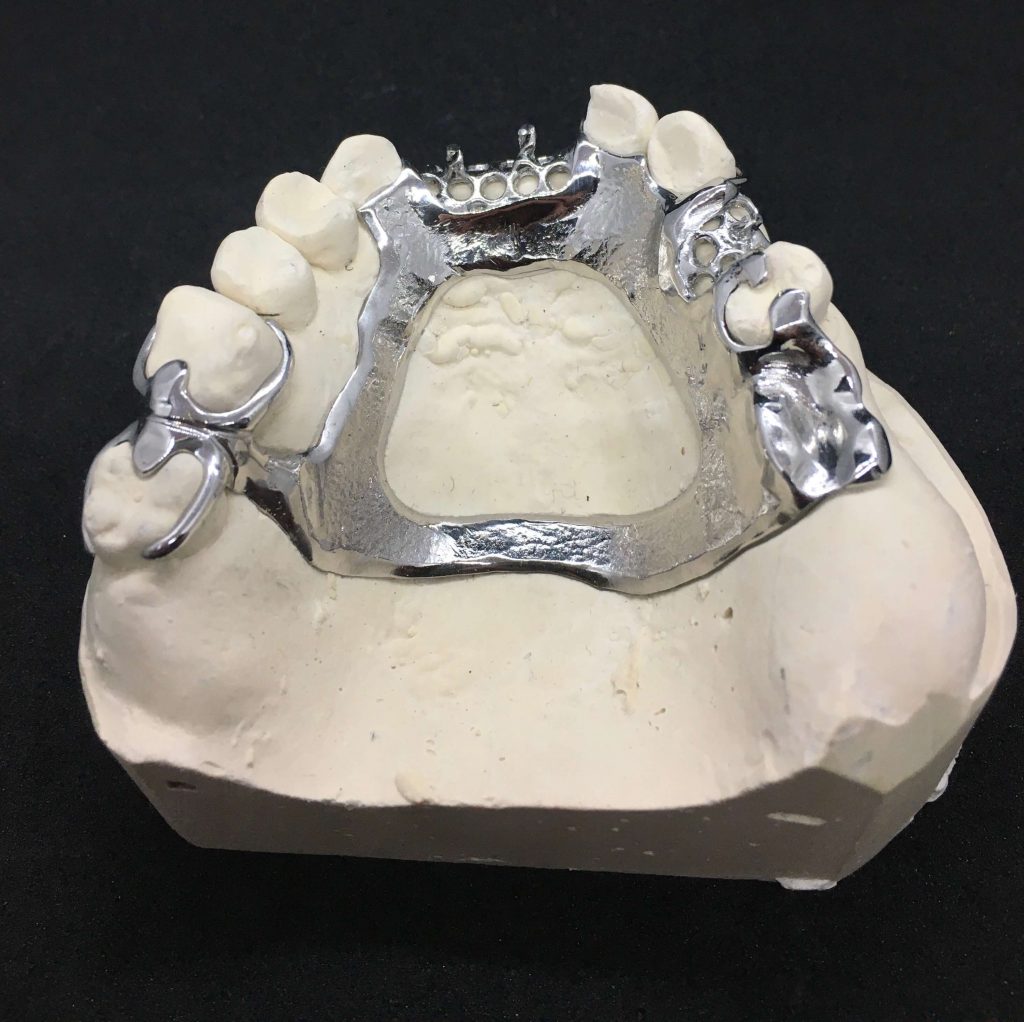
The metal framework is designed in a way to give the best support and function of the denture while keeping in mind aesthetics. It is understandable that the less you see the clasps the better the denture will look however there needs to be a balance between function and cosmetics.
Occasionally, the denture may require ‘rest seats’ to help seat it in the mouth and prevent unwanted movement. This involves a dentist making a small grove on the surface on one or two of your natural back teeth and the metal framework will have a corresponding piece that sits right in there.
PROS
- The metal part is less bulky than the all acrylic type of partial (see below)
- The metal clasps are more stiff/rigid and thus are stronger with less chance of deforming
- Use rest seats to allow for better stability of the denture
- Roof of mouth less covered which means less chance for gagging and allows you to taste of the food you eat
- Less prone to break
CONS
- Cost more when compared to acrylic partials, (due to the need of a metal framework)
- Take more time to make because the metal framework needs to be fabricated at a dental lab
2. Acrylic Partial Denture – this partial denture is made entirely out of acrylic, (pink denture material), and will use anywhere from 2-4 wire clasps around natural teeth to help hold it in place.
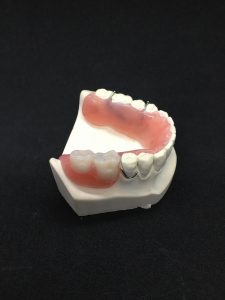
They tend to act more as an interim denture, for example, when natural teeth are in the process of being extracted. During the healing process after extractions you don’t have to go without any teeth so an acrylic partial would be worn during this time. After healing, a final cast partial denture can be made.
Some individuals do choose this type of partial to wear long-term since it costs less than a cast partial denture, but because it relies more on the gums for support, the gums can be stripped away from the teeth leading to possible oral damage and tooth extraction in the future, unlike a cast partial which utilises stronger clasps and a metal framework.
PROS
- Less expensive than cast partials and don’t take as long to make
- Replaces any missing teeth allowing for full smile, proper eating and speech
- Possibility of adding a denture tooth at a future time (for example, if an natural tooth is lost or extracted)
CONS
- More bulky when compared to cast partials
- Clasps are more prone to distort a bit, however, they can also be adjusted to loosen/make tighter
- Roof of mouth may be covered a bit more, which may prevent full taste of food
- More prone to break
- Gums/oral tissues at risk of being damaged and stripped away slightly
How Many Appointments are there for Partial Dentures?
There are generally 4 appointments needed for a partial denture:
Initial impression of the mouth is taken using a tray filled with alginate material and the way the natural teeth bite is recorded.
Measurements are taken using wax blocks which are placed in the mouth to mark where teeth should go, also the bite is recorded (if it wasn’t by the first appointment) and the colour/shade of teeth is chosen matching the colour of any remaining natural teeth.
- Trying in the denture teeth set to see how it looks. Any changes can still be made at this point, for example, if the midline of the teeth should be changed.
- Final Denture Inserted and any minor adjustments are also made at this point.
Possible additional appointments would be:
a second impression taken of the mouth using a custom sized tray giving a more accurate result, (this is done after appointment 1).
extra try-ins of the dentures (if any changes were made)
- any further adjustments needed (after having worn the denture for a day or week).
These would be included in the price of the denture. Typically any adjustments needed within 3 months of wearing the dentures are also included.
As a rough guide, the cost of cast partial dentures usually falls in a range between $1700-$2500 per arch, (meaning for just the upper or lower). The cost of an acrylic partial denture usually falls in a range between $1200-$1400.
Now, this price can change based on a variety of factors. There are higher quality materials and teeth that can be used. Also if the partial denture is being held in the mouth via dental implants, these would cost much more. Please see our Pricing Section for much more details on the cost of dentures.
Not having a partial denture can negatively affect your appearance as well as the health of your remaining natural teeth.
- Cosmetics: If it is your front teeth you are missing, aesthetics would play a large role in your decision to get a partial. A full smile plays a large role in our self confidence and social relationships.
Speech: Not having front teeth directly affects speech, as our front teeth play a major role in the way we make sounds with our mouth and tongue.
- Drifting Teeth: Teeth that are adjacent to the gap can shift and lean into the empty area trying to fill it. This can cause long-term damage to those natural teeth. A partial denture would fill in the missing teeth and lend support to those neighbouring teeth.
Over Erupting Teeth: Natural teeth opposing a space of missing teeth, (for example, if there are teeth missing on the bottom, but real teeth on the top), can over erupt, and can eventually lead to needing those teeth to be extracted. If more teeth are lost then the bone in our jaws will be lost, because natural teeth anchored into our mouths help maintain bone structure of the jaw in that area. Less jaw bone means more prone to fractures, less biting force and less chance of putting a dental implant anytime in the future.
It is just as important to get a partial denture for back teeth as it is for front teeth. Remember that cosmetics and aesthetics is not the only thing to consider.
Our back teeth play a large role in chewing our food. If food is not properly chewed and broken down then this can result in poor digestion and eventually leads to lacking the necessary nutrition we need.
Not replacing front teeth with a denture can result in:
- an incomplete smile
- issues with speech
- problems with biting food
- inadequate lip support
Get that front tooth replaced before the teeth next to it start to shift into the gap.
Sometimes called a ‘Flipper’, a single tooth partial denture can be made to replace a missing tooth. The will typically cost much less than a partial replacing many teeth, (they range around $700-$1000). They also don’t take as long to make as a cast partial or acrylic partial denture.
Metal clasps, (which hook around natural teeth) can also be added to them to help prevent them from falling out of the mouth. Adding clasps would mean an increase in price.
This type of denture is really for aesthetics and not so much function. A single tooth, (for example, if you are replacing a front tooth), can break easily so one has to be extra careful if it is being worn while eating.
The other option to replace a single tooth is to get a dental implant from a dentist. The benefit here is that an implant is a single tooth sitting on a post vs. a denture where the top of your mouth, (the palate), would be covered with pink denture material. However, implants cost much more, (Thousands of dollars), and may not be right for everyone based on their financial situation and their oral health conditions needed to receive an implant.
Think about wearing a new pair of shoes. It will take time for your mouth to get used to a newpair of dentures. The muscles of your face and mouth need time to adjust to speaking and eating with the new dentures. It is recommended to start off eating softer foods and then slowly move up from there. With speaking, it is suggested to practice reading out loud. Be patient and remember that with time you can have a pleasant experience adjusting to new dentures.
First of all do not attempt to repair the denture yourself, (for example, with any type of glue).This can easily result in a misalignment of the denture and will probably lead to your denture breaking again. Most broken dentures can be repaired the day of, (for example, a clean break down the middle), but there are cases where an impression of your mouth may need to be taken.
Yes it is possible. It depends on if the shape and type of the partial denture allows for a tooth addition. The denture and your mouth would need to be examined and the best course of action would be determined. If I tooth can be added, we would match the shade of the tooth and place it in a position that provides the best function and aesthetics.
With a denture brush, and warm water with a little bit of soap, gently brush all surfaces of the dentures. It is best to do this over a towel or a sink full of water in case the denture is dropped. Never use toothpaste because it is abrasive and can scratch your denture. Your mouth also needs to be brushed, (here you would use toothpaste). Brush your gums lightly as well as any natural teeth you may have. When your denture is not in your mouth, such as when you take it out at night, it should be placed in a small container with water to prevent the material from drying out.
Most dentures should last anywhere between five and seven years, with the first few years having the best fit and function. Keep in mind denture teeth will wear down quicker than natural teeth and the pink material, acrylic, which the denture is made out of is prone to stains and odors. Our mouths and jaws also go through lots of changes so It is vital to have a properly fitting denture so as not to compromise our overall health.
Unlike full dentures, (which relies on suction to the roof of your mouth the stay up), partial dentures (ie. when you still have some of your natural teeth left), will have thin metal clasps to hold onto some of your teeth to help hold the denture, (in addition to what was mentioned above with complete dentures). We can design where the clasps can and should go always keeping in mind aesthetics, (ie. trying our best to hide the clasps under the lip so it goes unseen), and function.
The appointments are done usually within a month, although a week or two extra made be needed for any additional try-ins or adjustments.
The denturist has a lot of work to do at the lab in order to make the dentures which is why time is needed. This includes:
- pouring stone models of your mouth based on the impressions taken
- setting denture teeth
- carving wax to mimic gums
- processing the denture into acrylic material
- trimming and polishing the dentures
- with cast partials, the metal frame also needs to be made and processed
If any tooth extractions are needed, (for examples, any teeth that need to be pulled by a dentist before a partial is made), then the time until you get your new dentures will increase because time is needed to allow your gums to heal. This can be anywhere from 5-8 weeks.
As mentioned above, after having teeth extracted, you don’t have to go without any denture until everything has healed. An ‘Immediate Denture’ can be made which acts as an interim solution until the final denture is made.
For a first time wearer of dentures, it will take more time to get used to them, much like wearing a new pair of shoes. The muscles of the face and mouth need time to adapt to the denture.
Putting in and taking out the partial can require some practice. The denturist will show you the correct path of insertion, (for example, inserting one side first before you the other), and it can take some getting used to. Never bite the denture into place.
Sometimes the clasps hooking around natural teeth can be a bit uncomfortable. In most cases, these can be tightened or loosened by a denturist.
If you already wear a denture, a new one will also feel a bit different at first, but with time you will accustom yourself to them.
It can take anywhere from a few weeks to a couple of months to get used to a new partial dentures. Some tips are to start off eating softer foods before moving onto harder ones and practice speaking/reading out loud to get your facial muscles used to the dentures.
HOW CAN WE HELP?
Send us a quick message to get in touch!
After filling out the form, we will simply send you an email back or give you a call if you choose to leave your number.